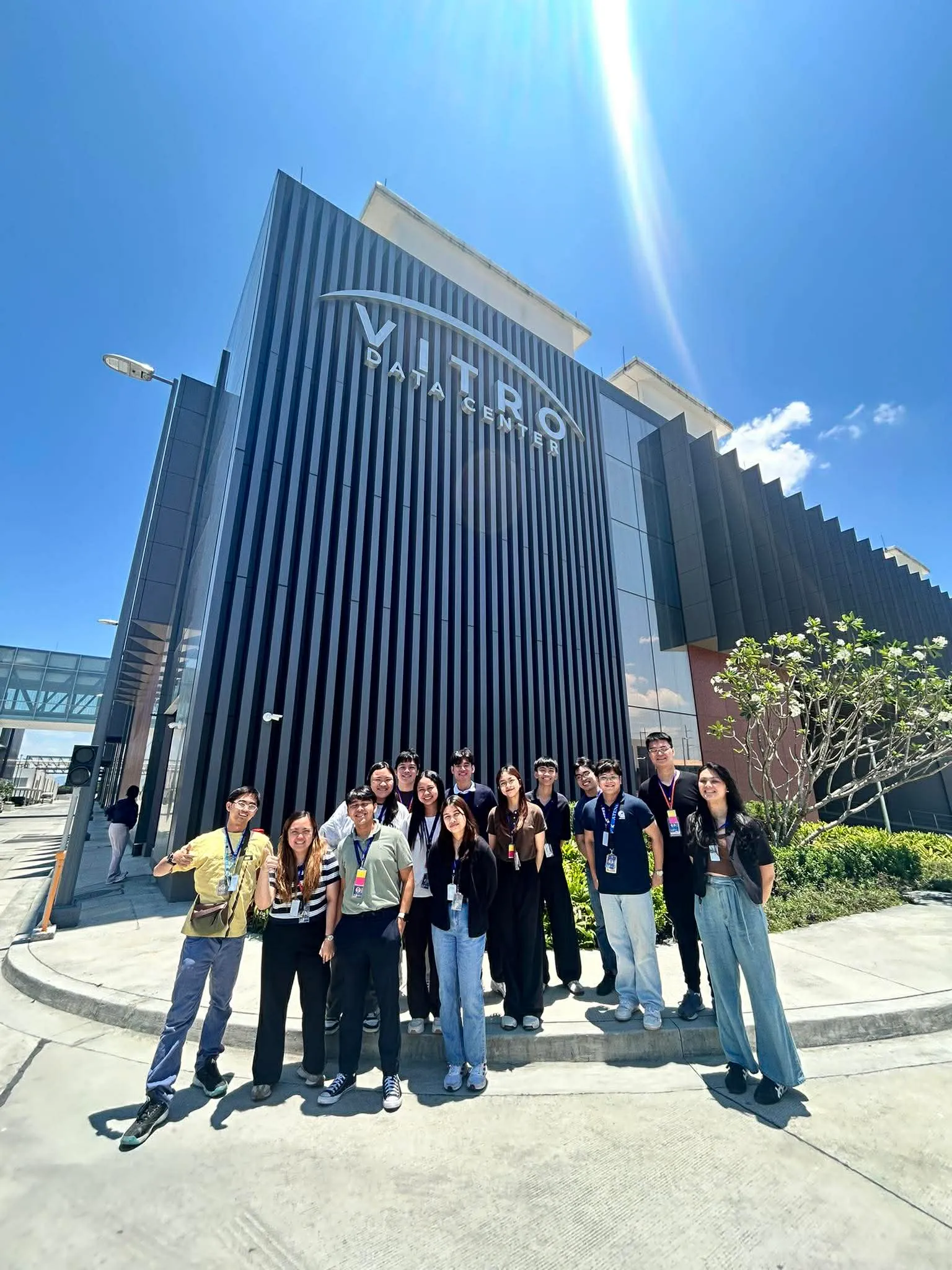
Last week, AECES brought us to Vitro’s data center in Sta. Rosa, Laguna as part of the SINAG ‘26 Company Tour. Before the visit, I had the same mental picture of a data center that most people probably have: rows of servers, blinking lights, cold aisles, the stuff you see in stock photos. By the end of the day, that picture felt embarrassingly small.
A data center is not really a networking project
The first thing that hit me was how little of what I saw was “network engineering” in the way we learn it in class. The racks and switches are there, sure. But they only get to do their job because the building around them is doing a lot of quieter, harder work.
A data center is a civil engineering project. It’s a mechanical engineering project. It’s an electrical engineering project. The networking bit sits on top of all of that, and if any one of those underlying layers stops holding up its end, nothing on top matters. That was the thought I kept coming back to the whole tour: the network is the visible product, but it is nowhere near the whole product.
Power is the part I keep thinking about
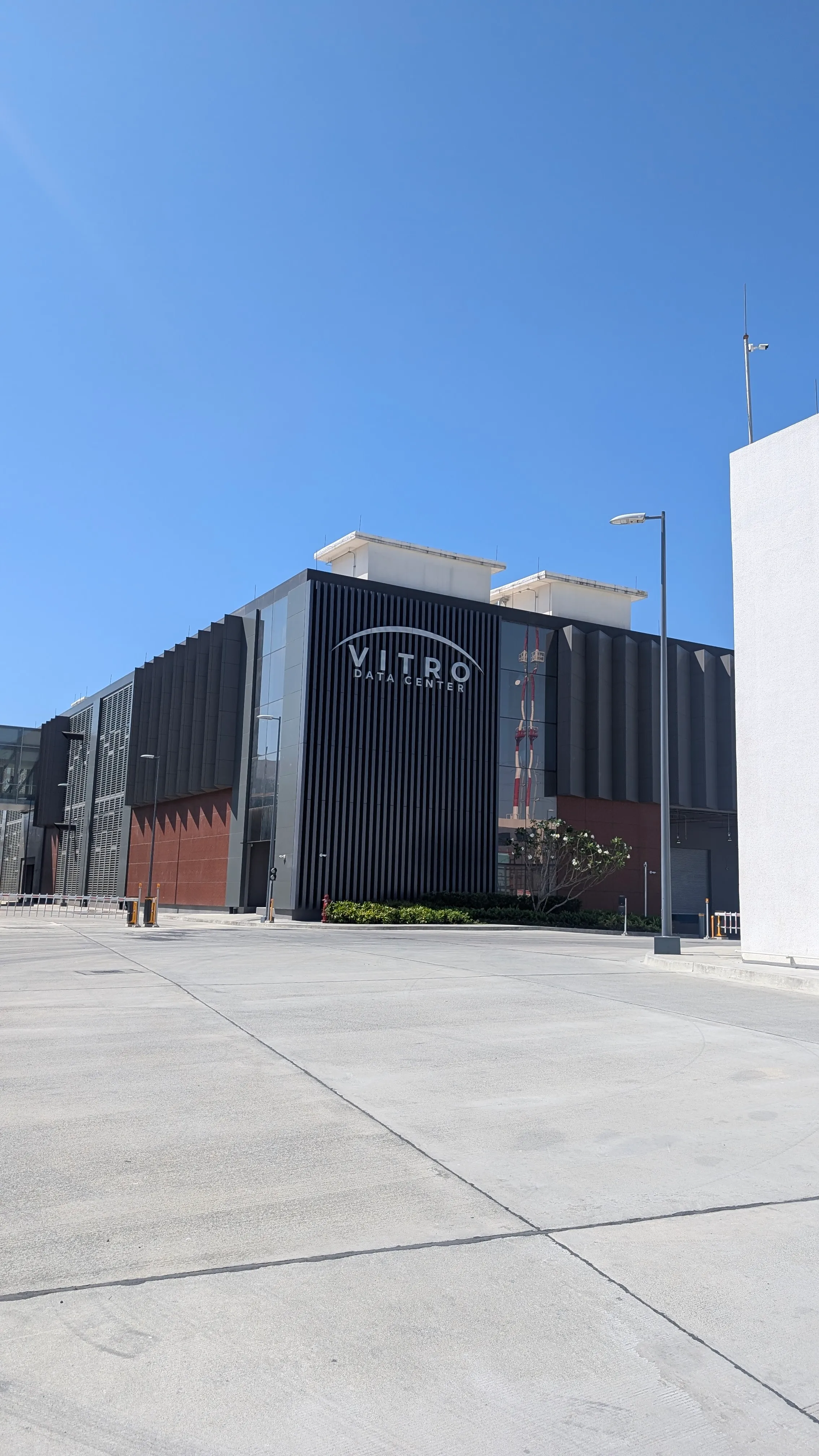
The power side reshaped how I think about scale. Vitro Sta. Rosa is rated for 50MW across the campus. That is not a server room. That is a small town’s worth of electrical load sitting inside one facility, and every watt of it has to stay steady.
Having a contract with an energy provider isn’t enough on its own. Especially not in the Philippines, where the grid can hiccup for reasons that have nothing to do with your facility. So you build redundancy behind your redundancy. Primary power, backups for the primary, and something fast enough to cover the seconds between a grid failure and a generator spinning up. The entire point is that when something goes wrong on the utility side, the servers don’t notice. That sounds simple as a sentence. It is apparently very not simple in practice.
Buildings, fire, and people you never see
The second thing that stood out was how much of the facility is about keeping the building itself trustworthy. You can have the best network in the country and it won’t matter if the roof leaks, the room overheats, or the wrong person walks in.
Site selection, structural integrity, fire detection and suppression, surveillance, access control, and a security team that is actually paying attention, these aren’t add-ons. They are part of what the customer is paying for. A data center is also a confidentiality promise. Keeping that promise takes people and systems most tenants will never interact with directly.
Data centers are not just cloud
One small clarification that came up for me during the tour. When people say “cloud” they usually mean services like AWS, Azure, or GCP, which are a specific commercial layer on top of data centers. A data center itself is the physical facility. It hosts cloud regions, yes, but it also hosts telco equipment, banks running their own private infrastructure, government systems, enterprise colocation tenants, and plenty of workloads that never touch a public cloud. Cloud is one of the customers. The data center is the building, the power, the cooling, and the people keeping all of it alive.
That distinction matters because local data center capacity isn’t only about whether the country has cloud services. It is about whether Philippine businesses, telcos, and government can run their own systems here, instead of entirely depending on facilities in other countries.
AI is changing what this infrastructure has to do
The other thing worth calling out is how much the bar has moved recently. Vitro Sta. Rosa is the Philippines’ first AI-ready hyperscale data center, and it is built around GPU workloads, including a GPU-as-a-Service offering. That is a pretty different design target from a traditional enterprise data center.
AI training and inference are power-hungry and heat-dense in a way classic web and database workloads never were. Racks that used to draw a few kilowatts are now expected to handle much more, which changes cooling, power distribution, and floor layout all at once. What I took from the tour is that being “AI-ready” isn’t a marketing sticker, it’s a real engineering decision baked into how the campus was designed. And if the Philippines wants to host any serious slice of AI work regionally, facilities like this one are the baseline, not the ceiling.
The part that is bigger than Vitro
The thing that stayed with me longest wasn’t technical. It was realizing how much of Philippine digital life actually lives inside buildings like this one. When businesses run in the cloud, when Filipinos bank, stream, study, and work online, a chunk of that quietly depends on whether local facilities can keep operating at the scale and reliability the rest of the world now takes for granted.
With compute demand climbing the way it is, being permanent importers of this kind of infrastructure isn’t really an option. We need to build, run, and staff it ourselves. That’s a workforce problem as much as a capital problem.
Vitro Academy made the most sense at the end
That’s why Vitro Academy clicked for me by the time I walked out. Training the next batch of Filipino data center engineers isn’t marketing. It is a bottleneck. You can put up buildings, sign power contracts, and buy equipment, but if you don’t have people who know how to operate all of it, none of it runs. A company investing in that pipeline directly was honestly one of the more hopeful things I saw that day.
What I left with
I came in expecting to learn about network gear. I left thinking about civil engineers, mechanical engineers, electrical engineers, security teams, and the students Vitro is training now to keep this industry running ten years from today.
Big thanks to AECES for putting SINAG ‘26 together, and to the Vitro team for opening their doors to us.